
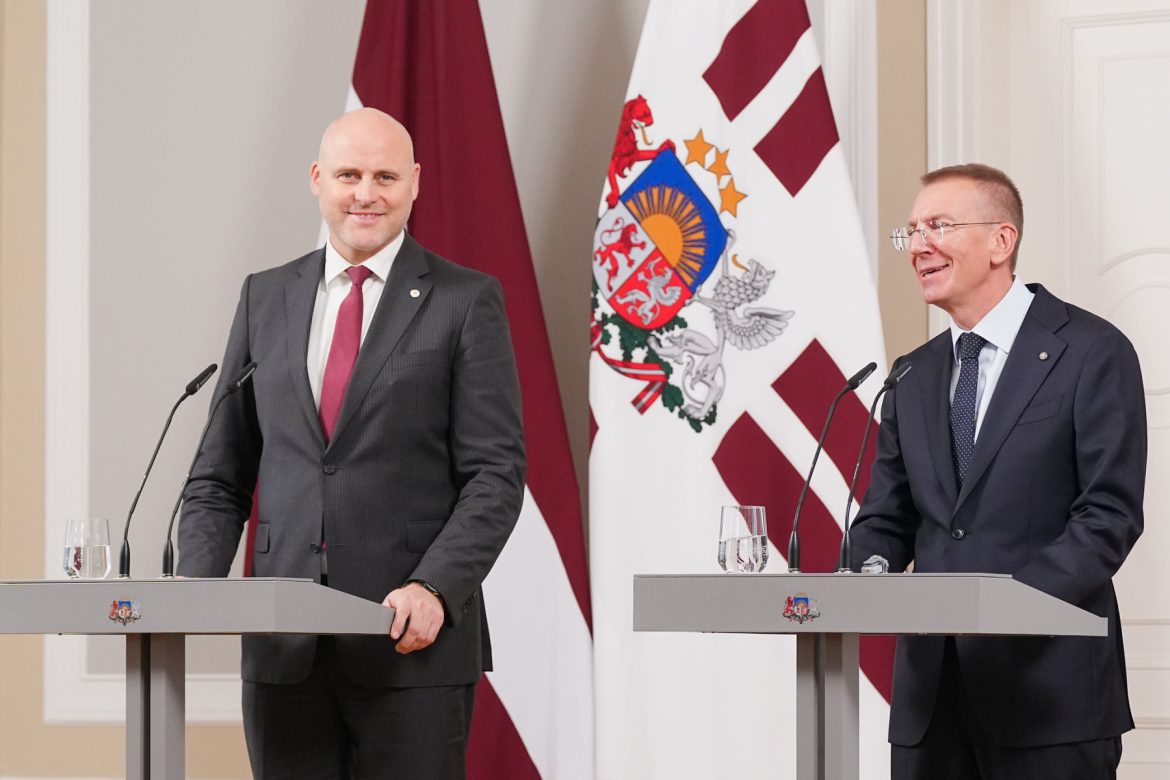
On Tuesday, 6 October, President Edgars Rinkēvičs announced as expected that he would entrust the formation of the new Cabinet of Ministers to the current Prime Minister, Andris Kulbergs, whose party, the United List (AS), won a record number of seats – 41 – in the 15th Saeima elections.
Rinkēvičs said this in a media briefing after meeting with Kulbergs.
“Having held discussions with all the parties elected to the next Saeima and their representatives, I have concluded that all political forces respect the election result, that the United List and Mr Kulbergs enjoy broad support from other parties – not all, but the majority – to begin forming a government in accordance with the very impressive mandate given by the public,” announced the head of state.
“A 41-vote majority in the Saeima is something unique. Everyone is prepared to talk and consult with the ‘United List’ and Mr Kulbergs regarding the formation of a government. We have agreed that the current Prime Minister will also become the candidate for the post of Prime Minister, and will hold talks with the political forces elected to the Saeima regarding both the government coalition and the division of responsibilities and tasks to be undertaken, which will result in a draft government declaration,” said Rinkēvičs.
The President may officially nominate a candidate for the post of Prime Minister after the newly elected Saeima has convened and the current government has resigned. However, the President may hold informal consultations with the parties that have won the election and publicly name a potential candidate for the post of Prime Minister, so that the parties can form a coalition and draft the new government’s policy statement in good time. Such a statement by the President has political, not legal, force. The newly-elected Saeima will convene for its first sitting on 3 November.
The leaders of the United List have previously stated that they will first hold talks on the new government with their existing coalition partners – the National Alliance (NA) and New Unity, which won 10 and 7 seats respectively in the 15th Saeima. Such a coalition would have 58 votes in the Saeima.
At the same time, the potential future Prime Minister emphasised that he does not wish to cooperate with the party Latvia First, which achieved the second-best result in the Saeima elections, winning 17 seats. One of the reasons cited was the election to the Saeima of the former mayor of Rēzekne, Aleksandrs Bartaševičs (Together for Latvia), of whom Kulbergs is not a fan.
Experts point out that, in theory, the next coalition could be formed by two parties – AS and the National Alliance – but it would have a slim majority; therefore, the most realistic coalition scenario is a three-party coalition, with New Unity also joining, though other models are also possible, according to Kulbergs’ preferred strategy.