
Kulbergs proposes €2.9 billion austerity plan: Where will the government find the money?
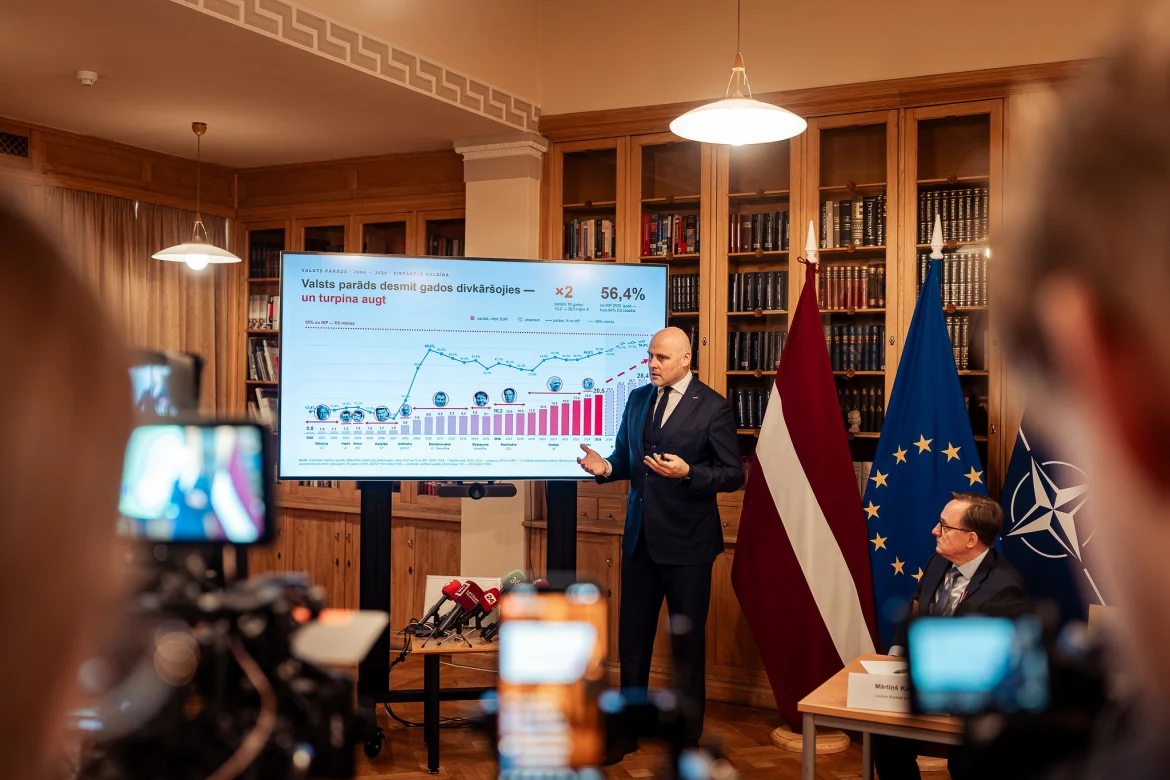
Prime Minister Andris Kulbergs (United List) proposes reviewing public administration expenditure, the administration of sick leave and benefits, and the allocation of state support over the next four years. The aim is to achieve a combined fiscal impact of €2.875 billion in 2027–2030.
Alongside the austerity measures, the prime minister proposes establishing a Latvian Development Fund to attract investment in housing, business development and defence manufacturing.
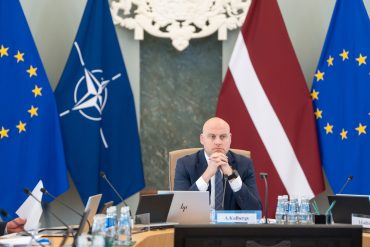
Kulbergs presented the proposals at a press conference on the state of public finances on 10 November. The figures in the presentation are targets and estimates; specific decisions on how to achieve them have yet to be made.
Target of €822 million next year
The fiscal impact proposed in the presentation is broken down by year: €822 million in 2027, €667 million in 2028, €675 million in 2029 and €711 million in 2030.
Of the €822 million planned for next year, €215 million is to come from one-off sources. This means that the full amount would not be generated by permanent spending cuts.
The presentation also acknowledges that the austerity measures could slow the economy. According to the calculation used, gross domestic product could be 0.5–0.7% lower than it would otherwise be, while government tax revenue could consequently fall by €90–130 million a year.
Largest savings sought in public administration
The largest contribution to improving the budget position is expected to come from a review of public administration and government agency expenditure: approximately €900 million over four years.
The presentation lists staff reductions, centralised procurement and the introduction of shared administrative services. The potential impact of staff reductions is estimated at €85 million a year, centralised procurement at €40 million, and shared administrative services at €35 million.
Another section mentions the possibility of approximately 3,000 to 6,000 public administration employees moving to the private sector, with retraining opportunities also envisaged.
Sick leave and hospital cooperation under review
The second-largest area consists of sectoral reforms, which are expected to generate approximately €650 million over four years.
Among the largest items are a review of the administration of sick leave and benefits, with an expected impact of €50 million a year, and the creation of a hospital cooperation network, with an annual impact of €40 million. A further €70 million a year is expected from other reforms, subject to decisions by the relevant ministries.
The presentation does not explain in detail how sick pay or hospital services would change.
Less universal support and changes to service pensions
Kulbergs also proposes reviewing the allocation of state support so that it is more closely targeted at specific groups of residents. The aim is to achieve an impact of approximately €190 million over four years in this area.
A further €40 million over four years is expected from limiting automatically increasing expenditure. This section mentions reform of the service pension system and a review of who is eligible for severance benefits.
The presentation does not provide a detailed new list of benefit recipients or set specific income thresholds. It is therefore not yet possible to determine whose support would change or by how much.
State-owned companies’ funds would also be used
A separate section brings together capital, revenue and one-off measures, with a planned impact of approximately €540 million over four years.
These include the use of surplus funds held by state-owned companies, generating €135 million as a one-off measure. The presentation also mentions a fixed personal income tax allowance, with an impact of €33 million from 2028, and an import duty on e-commerce shipments, with an impact of €21 million. Meanwhile, stricter discipline in the use of budget funds and a review of priority measures could generate a further €370 million over four years.
Development Fund to help attract investment
Alongside the spending review, Kulbergs proposes establishing a Development Fund that would initially bring together the state’s holdings in seven companies under a single governance model. The state would retain control of strategic companies.
The fund would issue €1.5 billion in bonds to attract investment. Of this amount, approximately €600 million would be allocated to housing availability and building renovation, €150 million to defence manufacturing and €450 million to business development, while €300 million would be kept in reserve.
With additional financing from banks, institutional investors and businesses, total investment in the economy could reach approximately €6 billion. The fund’s projections are based on the assumption that it will succeed in attracting investors and implementing the planned projects.
Kulbergs’ proposal also sets a target of achieving annual real economic growth of 4% by 2030 and increasing the number of people in employment to approximately 909,000 — 26,000 more than in 2025.
The presentation is available here: https://www.mk.gov.lv/lv/media/28369/download
Tēmas
Seko Puaro.lv
Vēl par tēmu
Skatīt vairāk-
 Kulbergs piedāvā 2,9 miljardu eiro taupības plānu: kur valsts meklēs naudu?
-
 President asks Kulbergs to form next Latvian government
-
 Igaunija aizliegusi, Kulbergs aizstāv Krievijas graudu tranzītu līdz ES lēmumam: tos nopirkuši sabiedrotie 13
-
 Kulbergs ieturēs pauzi jau tā nenotiekošajās valdības veidošanas sarunās 1



Komentāri (0)
Vēl nav komentāru. Pievieno pirmo komentāru.