
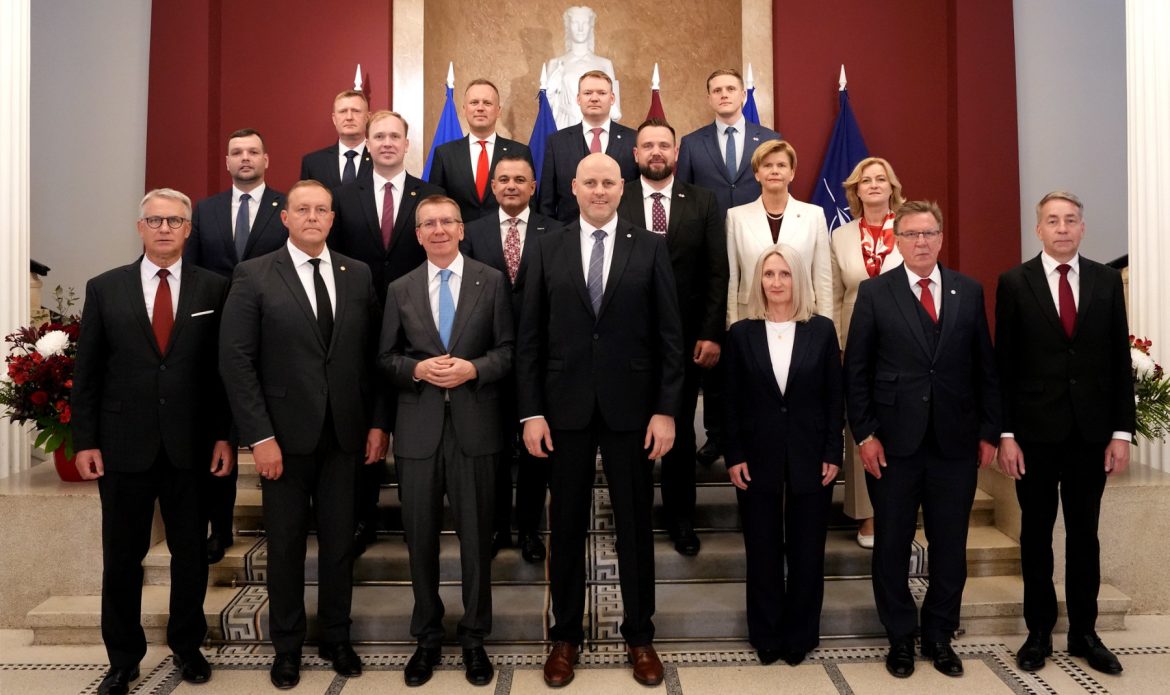
As expected, a new four-party coalition government was approved by Latvia’s parliament, the Saeima, on Thursday, May 28th.
The 100 Saeima deputies approved the new administration led by Andris Kulbergs (United List) exactly two weeks after the resignation of previous prime minister Evika Siliņa (New Unity) on May 14th.
The vote was 66 to 25 – which also gives an indication of the size of the coalition’s parliamentary majority.
The quick flip from one government to another is explained by the fact that the next Saeima elections are due to take place on October 3rd, so this government will be in power for a little over four months.
Speaking to parliament before the vote, Kulbergs said he was proud of the speed with which he had been able to form a government and that Latvia “needs an effective, professional and accountable government – a government with the desire to do things and take strong decisions.”
He identified his four priorities as “security, budget stabilization, fair elections and battling cartels and corruption.
“The economy goes hand in hand with security. Without security there cannot be an economy, and without an economy there will not be security,” said Kulbergs.
“There will be difficult and unpopular decisions – there is no other way – and we choose to speak honestly and honestly explain to society in clear language. That has to come into our modern politics,” he added.
Later in his speech he said: “We are at the top level in many things and are happy and proud about that. I always think when I’m here: ‘Why can’t our politics be number one? Why?’ I think it can be.”
Towards the end of his speech, Kulbergs held up a book published in 2013 titled ‘Mission Impossible‘ written by his father Viktors Kulbergs about his enthusiasm for vintage cars. This proved that “impossible things can become possible,” he stated.
As previously reported, the new coalition consists of two parties that were in the previous coalition – New Unity and the Greens and Farmers Union (ZZS) – and two parties that were in opposition, the United List and the National Alliance.
Though describing the ideological position of any Latvian political party, let alone a whole coalition, is usually a complex affair, for the benefit of foreign observers this coalition could best be described as right-of-centre but not far right, with the overtly nationalist National Alliance on one wing and the EPP-affiliated New Unity on the more centrist side.
Foreign observers will also note that the incoming cabinet is male dominated, which somewhat undermines Latvia’s aspirations to be seen as a modern Nordic/Scandinavian type democracy. Of 15 ministerial portfolios (including the Prime Minister), only two are held by women: Baiba Braže (New Unity) will continue as Foreign Minister and Ilze Indriksone (National Alliance) will take up the post of Education and Science Minister.
New Prime Minister Andris Kulbergs has promised to avoid divisive issues during his four-month tenure but has also said that he will urgently review the current state budget.
The government declaration – a rough guide to what it intends to do – runs to just 1,500 words but manages to include 52 different points.
Border security and anti-drone measures are singled out as the first priority – hardly surprising given that it was drone incidents that brought the collapse of the previous government, but there is also a promise to develop “a compensation mechanism to cover the losses caused by drones.”
Other items on the government ‘to do’ list include “stepping up controls on immigrants” and “restricting the issuance of new long-stay visas and residence permits to foreigners” along with the continuation of “comprehensive support for Ukraine” in its defence against Russian aggression.
The new government promises to “tackle economic crime, corruption, cartels and sanctions offenders with the utmost force of the law” and that it will “carry out an evaluation of the budget base expenditure in all ministries” and make public procurement processes more transparent. There is also the perpetual promise of all incoming administrations that it will reduce bureaucracy – whether much can be done on this matter in four months is questionable, but in keeping with many of the other items on the government agenda, it has the ring of laying groundwork for what might be a longer-lasting coalition after the October elections.
The Kulbergs-led government vows to come up with a “model for the future direction of the [Rail Baltica] project” and says it will examine national airline airBaltic’s business plan “by August 2026 and take a decision on future scenarios”.
The distribution of ministerial portfolios is as follows:
Minister of Agriculture – Uldis Augulis (Union of Greens and Farmers)
Prime Minister – Andris Kulbergs (United List)
Minister of Finance – Māris Kučinskis (United List)
Minister of Justice – Edvards Smiltēns (United List)
Minister of Smart Administration and Regional Development – Edgars Tavars (United List)
Minister of Foreign Affairs – Baiba Braže (New Unity) retains her post
Minister of Defense – Colonel Raivis Melnis (nominated by New Unity)
Minister of Transport – Rihards Kozlovskis (New Unity)
Minister of Health – Hosam Abu Meri (New Unity) retains her post
Minister of Education and Science – Ilze Indriksone (National Alliance)
Minister of Culture – Nauris Puntulis (National Alliance)
Minister of the Interior – Jānis Dombrava (National Alliance)
Minister of Climate and Energy – Jānis Vitenbergs (National Alliance)
Minister of Economy – Viktors Valainis (Union of Greens and Farmers) retains his post
Minister of Welfare – Reinis Uzulnieks (Union of Greens and Farmers) retains his post